There is no single “lead generation tool” that creates an MSP pipeline. There is a sequence of operational decisions. When those decisions are disconnected, outreach becomes an unpredictable volume exercise. When they are connected, a team can see what is happening, protect its sending assets, and improve the parts that need work.
This guide covers the system from first target-account decision through the moment your sales team receives a qualified reply.
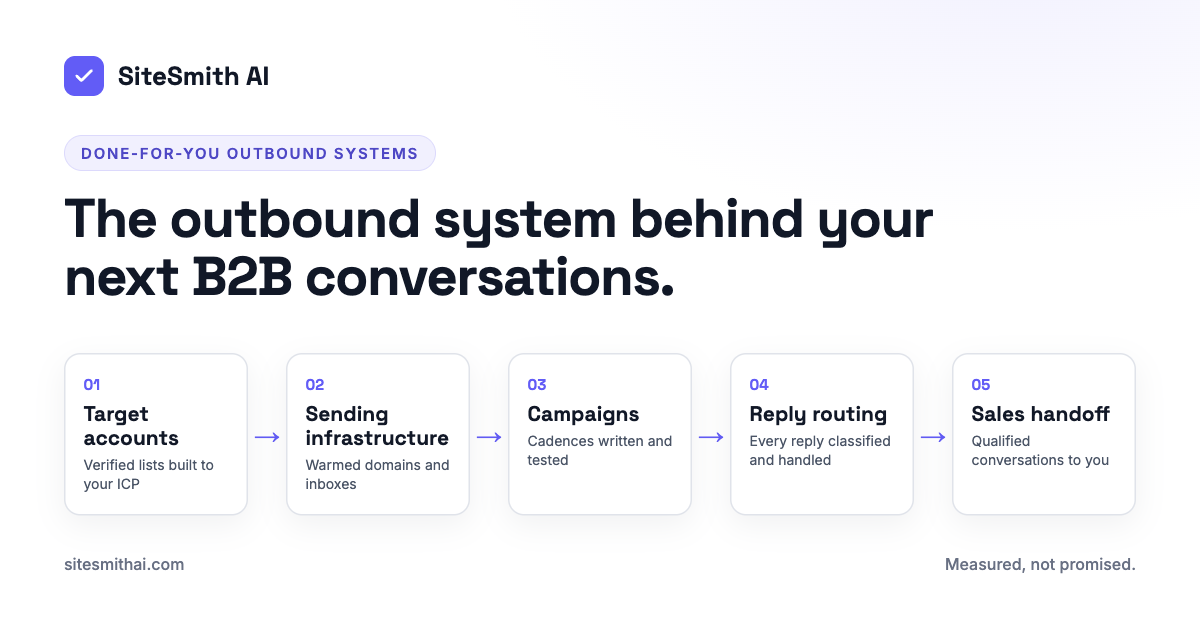
An MSP outbound system, as SiteSmith builds it, is five connected decisions rather than one tool. First, a target-account definition specific enough to guide research: company size in users or endpoints, geography, industries with real proof, the buying role that feels the pain, and the disqualifiers. Second, sending infrastructure treated as an asset: dedicated domains and inboxes, authentication, gradual volume, email verification, suppression, and a named owner for remediation. Third, a first message written for a real reason to talk, in the buyer's language, with one call to action. Fourth, a reply taxonomy designed before the first reply arrives, covering interested, objection, referral, wrong contact, later, unsubscribe, and out of office, each with an owner and a next action. Fifth, measurement of the whole chain from deliverability through positive replies, qualified conversations, meetings, and wins, so a weak stage can be found and fixed instead of blaming outbound as a whole.
1. Build a target-account definition that sales can use
A usable ICP is a decision tool, not a slogan. “Businesses that need IT support” will not help a researcher select accounts or help a seller decide which replies deserve attention. It needs choices about service fit.
Start with the MSP’s current best clients. Look for the recurring patterns: user count, endpoint complexity, geography, industry, compliance pressures, internal IT presence, and the operational reason they buy. Then state where the MSP is not a fit.
For example, an MSP may decide that it can serve professional-services firms in a multi-city territory with 25 to 150 users, a buyer who owns operations, and no internal IT team. That is not the only valid definition. It is simply specific enough to guide research and message testing.
2. Treat sending infrastructure as an asset
Sending domains and inboxes are operational assets. A poor list, rushed volume, or weak suppression practice can damage them. Build the infrastructure before launching outreach, and separate it from important day-to-day business mail.
The operational checklist should cover dedicated sending identities, authentication and configuration, gradual usage, email verification, suppression handling, deliverability observation, and a clear owner for remediation. The exact tools can change. The responsibility cannot.
Keep a record of who has been contacted and who asked not to be contacted. That is both good operational hygiene and a prerequisite for a system you can responsibly scale.
3. Write for a real reason to talk
MSP prospects receive generic messages constantly. The first note earns attention by being relevant, brief, and honest about why it was sent. It does not need to describe every service. It needs to establish that the sender understands the buyer’s operating context and has a reason to start a conversation.
Use the language your buyer uses. For an MSP, that might mean talking about users, endpoints, co-managed IT, business continuity, response expectations, or a specific service model. Avoid pretending you detected an unknown security problem or know a prospect’s technology stack when you do not.
One focused call to action is enough. Ask whether the topic is relevant, offer a short conversation, or invite a response with a simple qualifier. A first message is not a proposal.
4. Design reply handling before the first reply arrives
A campaign does not create value until a person can act on a reply. Build a taxonomy before launch: interested, objection, referral, wrong contact, later, unsubscribe, and out of office. Each label should have an owner and next action.
Interested replies should reach the sales owner fast, with the original context attached. Objections should be reviewed for message and ICP learning. Unsubscribes should be suppressed immediately. A reply that waits in a shared inbox becomes a lost learning opportunity, even when it was not a booked meeting.
For MSPs, the responder should be able to explain service fit and ask sensible questions without overpromising technical or compliance outcomes. This is why an outbound system needs a sales handoff and not just an alert.
5. Measure the chain, not one vanity number
Track deliverability, raw replies, positive replies, qualified conversations, meetings held, sales conversations, and eventual wins. These stages answer different questions.
- A high bounce rate points toward data or verification issues.
- Low replies can point toward relevance, deliverability, market, or copy.
- Replies without positive interest can point toward targeting or offer fit.
- Positive replies without meetings can point toward response speed or sales handling.
- Meetings without opportunities can point toward qualification or the offer itself.
SiteSmith’s own campaign results show measured deliverability and reply figures. They are not a prediction for an MSP campaign. Your campaign should be measured against its own agreed test criteria.
6. Run a contained test before calling it scalable
Launch with a defined initial cohort, a known sending cap, and a review date. Do not keep adding volume to a campaign that has not earned it. Check bounces and complaints before loading the next tranche. Read replies rather than counting them only in a dashboard.
Write the decision rules in advance. What response quality would justify a second test? What would cause one message or targeting revision? What result would lead you to pause the vertical? A pre-committed rule is more reliable than explaining a disappointing outcome after the fact.
Where to go from here
If your MSP still relies mostly on referrals, begin with our guide to building a predictable pipeline beyond referrals. If you want help assembling the system, see the outbound system for MSPs that SiteSmith builds.
Sources and editorial note
SiteSmith publishes practical operating guidance and cites external sources for factual industry and security claims. This article is not legal, regulatory, or cybersecurity advice.