Many managed service providers grow because their work earns trust. A client recommends the team to another owner. A technology partner makes an introduction. A founder’s reputation opens a door. That is valuable pipeline, but it is not a controllable system.
Current industry research supports the underlying problem. Kaseya’s 2026 State of the MSP report says new-customer acquisition is the top challenge for 71% of respondents. ConnectWise’s 2026 MSP Marketing Report says referrals are a key business driver for 72% of MSPs. Those facts do not mean referrals are broken. They mean a growth plan built only on referrals has a concentration risk.
Start with the MSP you are, not the generic MSP category
“MSPs” is too broad to be a market definition. A local generalist serving ten-user professional offices, a security-led provider in healthcare, and a co-managed IT firm selling into mid-market manufacturing have different buyers, language, contract sizes, proof, and objections.
A predictable MSP pipeline beyond referrals starts with a narrow written definition of the account the MSP can confidently serve, not with a list or a tool. Kaseya's 2026 State of the MSP report puts new-customer acquisition as the top challenge for 71% of respondents, and ConnectWise's 2026 MSP Marketing Report says referrals are a key business driver for 72% of MSPs. Referrals are not the problem. A plan built only on referrals is a concentration risk. The second source works when three things hold: the target account is specific (size in users or endpoints, geography, industry proof, buying role, disqualifiers), the first message gives a credible reason for contact rather than impersonating a referral, and a prepared person on the MSP's team works interested replies quickly. MSP buying is trust-heavy because the provider will touch devices, networks, backups, Microsoft 365, and security controls, so the message has to earn attention and invite a low-friction next step.
Before sending anything, write down the narrowest version of your target account that your team can confidently serve. That usually includes:
- Company size, using employees, users, or endpoints as an initial qualification signal.
- Geography and whether service is local, regional, or remote.
- Industries where the team has real proof or operational comfort.
- The buying roles that feel the pain: owner, COO, finance leader, internal IT leader, or another operational decision-maker.
- Disqualifiers, including companies too small to support the service model or prospects without a reasonable sales fit.
This is not bureaucracy. It prevents the common failure mode where a campaign creates replies that the MSP does not want, cannot serve, or cannot convert.
Use outbound to earn attention, not impersonate a referral
MSP buying is trust-heavy. A buyer is not choosing a one-time commodity. They are considering a provider who may touch user devices, networks, backups, Microsoft 365, and security controls. CISA guidance on managed service providers reinforces why customers evaluate security, operational continuity, and accountability carefully.
That changes the purpose of the first message. It should not force a discovery call through a vague claim such as “we help businesses grow.” It should give a credible reason for contact, show that the sender understands the prospect’s business context, and invite a low-friction next step.
For example, an MSP with genuine experience in professional services might lead with a specific operational pattern it sees in that market, then offer a relevant assessment or conversation. It should not imply that it already knows the prospect has a security gap, is noncompliant, or is failing an audit unless it can prove that claim.
Build the delivery system before volume
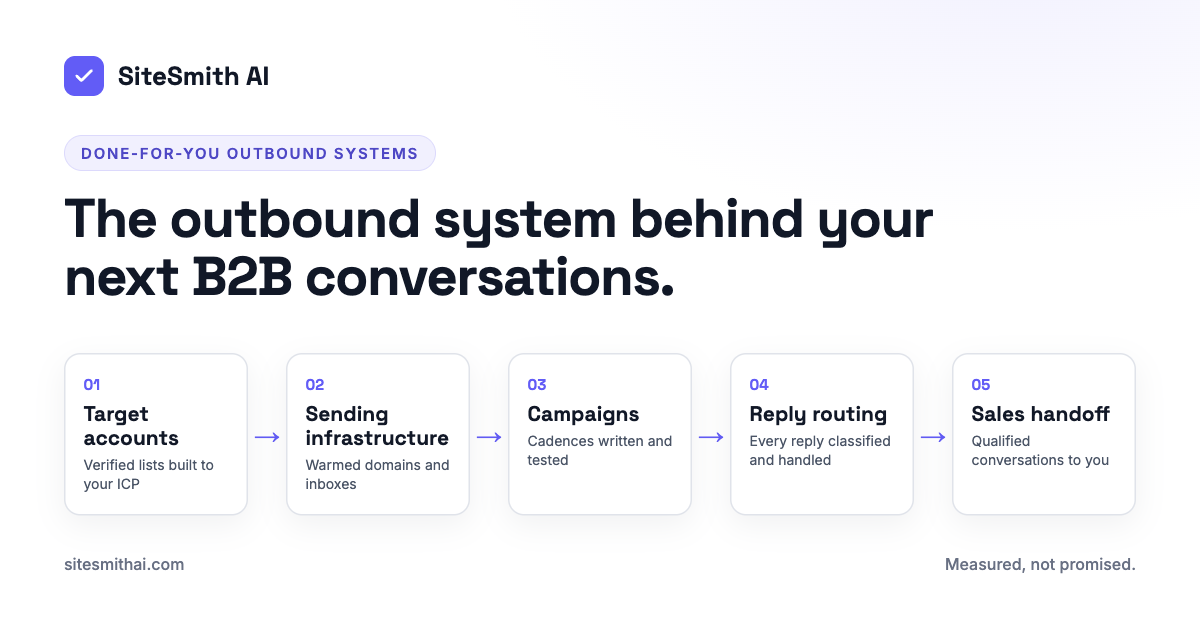
A campaign is more than copy and a list. It needs a working delivery system: account selection, data verification, dedicated sending infrastructure, suppression rules, messaging, reply classification, and an owner for follow-up. If any part is missing, the team will learn the wrong lesson from the outcome.
- Target accounts: research against the ICP and remove obvious non-fits.
- Verification: validate contactability and keep suppression records before sending.
- Sending infrastructure: protect the sending asset with sensible volume, monitoring, and clean operational boundaries.
- Reply routing: route positive, objection, referral, and unsubscribe replies to distinct actions.
- Sales handoff: define who responds, how fast, and what information that person receives.
That is why buying a contact file by itself rarely produces a dependable pipeline. A contact file does not know your service capacity or save a reply that waited two days for a response.
Make the sales response part of the campaign
The campaign does not end when a prospect responds. MSPs often have long consideration cycles and buyers may compare multiple providers. A thoughtful reply process is therefore part of the product.
Set an internal response standard, assign one accountable owner, and document the first follow-up. The goal is not to pressure every response into a meeting. It is to recognize the conversations worth advancing and preserve trust with the people who are not ready.
At minimum, track positive replies, objections, referrals, wrong contacts, unsubscribes, meetings held, and opportunities created. Those labels show whether the problem is targeting, message, offer, sales response, or simply low market fit.
Measure the right signals before making a niche decision
Raw sends are not a success metric. Start with delivery quality and reply quality, then connect qualified conversations to meetings and opportunities. A high reply rate made mostly of objections is not the same as a healthy pipeline.
For a new MSP campaign, use a defined test window and a pre-written decision rule. Decide in advance what would justify continuing, what would trigger one revision, and what would cause you to stop. That discipline prevents the team from keeping a weak campaign alive just because it has already invested time.
SiteSmith’s own campaign results can be reviewed on our results page. They are evidence from SiteSmith campaigns, not a promise of MSP outcomes. An MSP campaign must produce its own results.
What to do next
If referrals still drive most new business, do not replace them. Formalize and protect them. Then add a narrow outbound test where your team can respond well and learn quickly. Read our guide to building the underlying MSP outbound system, or explore the MSP outbound system SiteSmith builds.
Sources and editorial note
This guide combines SiteSmith’s operational perspective with current industry and security sources. We update factual claims when credible new evidence changes the picture.